
How is Georgetown Entrepreneurship Redefining Innovation Through Its Health Initiative?
When most people hear “health initiative,” they picture lab coats, biotech, and med school applications. Georgetown Entrepreneurship’s Health Initiative, led by Sara Medina (H’27), Aveline Argo (MBA’25), and Barbara White (Entrepreneur in Residence), challenges this view by redefining what it means to build in and around health. The initiative seeks to foster global discussions and student empowerment in an effort to advance entrepreneurship for the greater good.
During the recent Entrepreneurship in South Asia Summit and Entrepreneurship in Dermatology events, the initiative demonstrated that innovations in health are not just about scientific breakthroughs: they are about rethinking systems and who they serve.
What is the Entrepreneurship in Health Initiative?
The initiative started out as an attempt to increase health and wellness-related programs at Georgetown Entrepreneurship. Over time, however, its purpose has grown beyond hosting isolated events. It seeks to bring together students, faculty, and entrepreneurs through programming that provides both motivation for curious students and resources for those who have ideas they want to expand upon. The hope, according to Medina, is that “someone can take one line from these events and be inspired.”
The first goal of the initiative is to create targeted, accessible events for students who may be interested in medicine’s entrepreneurial applications but aren’t sure where to begin. By hosting conversations around topics such as global health and physician-led ventures, the initiative seeks to offer entry points into a space that can sometimes feel overwhelming. “I always meet someone who sparks an inspiring conversation at these events,” noted Medina.
The second goal is more resource-oriented. For students who have already developed an idea, the initiative hopes to provide structure and support through pitch competitions and access to funding. Medina hopes to further streamline these resources in the future, so that students who present at a competition are connected to mentorship and next steps.
What It Takes to Turn Scientific Research into a Real-World Product
At the Entrepreneurship in Dermatology event, students heard from Ivica M. Labuda, director of Georgetown’s School of Medicine Biotechnology program, about the process of transforming scientific discoveries into marketable products. She made it clear that research alone is not enough.
Reflecting on her own experience building companies, Biokeys for Flavors and NovaKera, Labuda emphasized that making scientific observations is only the first step. Real impact comes from translating research into solutions that address real consumer needs. In her perspective, the patents that she received for research were not endpoints themselves but foundations that needed practical application. “If you don’t put a patent in practice, it’s zero, it’s a piece of paper,” she said.
Labuda’s advice for aspiring healthcare entrepreneurs was simple. While having formal medical training is not necessary, it is always important to educate yourself on the science behind your idea, and, when stuck, seek out experienced partners who can help bring your vision to life. While breaking into a regulated, science-driven industry can feel daunting, she reassured students that “just like any business, you can always find a way.”
How Can Students Launch Healthcare Ventures While Still in School?
The Entrepreneurship in Dermatology event featured another student founder, Anant Bansal, who built an AI-powered app that analyzes skin conditions based on a selfie and recommends the best course of treatment.
Bansal didn’t wait for the perfect credentials: he began with customer discovery. Through ICORP, he interviewed more than 20 individuals and surveyed over 100 to identify pain points in his idea. He later refined his model by attending industry conferences, eventually taking it to Georgetown’s Bark Tank, where he won $5,000.
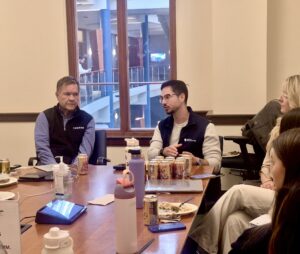
Bansal’s advice to fellow students was simple: “Start, start, start!” He echoes Labuda’s belief that the only way to know if something works is to actually try it, encouraging students to begin before they feel ready.
In response to students’ fears about the relevance of their ideas, he stated, “You can feel overwhelmed by everything that is already on the market, but you have to recognize that your own unique perspective and life stories do not exist in a product that is already out there.”
The Future of the Entrepreneurship in Health Initiative at Georgetown
The Entrepreneurship in Healthcare Initiative proves that innovation in health is not confined to hospitals or laboratories – it is found in pitch competitions, policy panels, and student-led experiments.
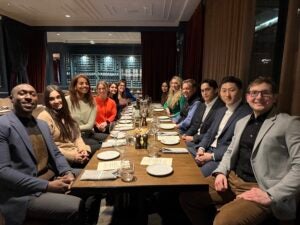
By connecting students with founders, Georgetown Entrepreneurship aims to empower young creators to see themselves as innovators and reflects our dedication to developing entrepreneurs who make impact, both through the ventures they start and the systems they influence.
That commitment will be put into action at the upcoming Entrepreneurship in Health Pitch Challenge on April 7 where any Georgetown student has the opportunity to present a health-related pitch to a panel of judges, receive feedback, and win prize money. The initiative is also developing an event for current and aspiring medical students who are interested in starting their own practices. It plans to cover the business, regulatory, and operational realities of independent care that do not often receive attention. Finally, we’re in the early stages of planning a panel on holistic healthcare that brings together nutritionists, physical therapists, and digital health leaders to explore how interdisciplinary collaboration can impact patient care.
More information about upcoming events can be found on the Entrepreneurship in Health page on the Georgetown Entrepreneurship website.